Grades 5 and 6 are not simply an extension of elementary school but a distinct bridge phase that prepares children for the demands of secondary school. In these two years, lessons become more challenging, students take on more responsibility, and assessment formats gradually move closer to what awaits them from grade 7. At ISR International School on the Rhine in Neuss, near Düsseldorf, Germany, this phase is deliberately designed as a step-by-step preparation for secondary school.
The move from elementary to secondary school is one of the most important steps in a child’s education. This article explains what makes grades 5 and 6 special from an educational point of view, how thinking and learning change at this age, which skills children build, and why an international learning environment can make a decisive difference.
What Makes Grades 5 and 6 So Special?
Grades 5 and 6 hold a unique position in the school system. They connect the child-centered learning of the early elementary years with the more structured, subject-based demands of secondary school. This phase is not just a moment of transition but an actively designed stage of development with its own educational logic.
At ISR, for example, students in grades 5 and 6 receive homework every day, keep their own school planner, and use the school’s learning management system, Schoolbox, to track assignments and deadlines. These routines are not an end in themselves but targeted preparation for middle school.
Another feature of this phase is the introduction of a third language from grade 6. In addition to English and German, students choose between French, Spanish, Japanese, and Chinese. This shows that the bridge phase is a time of broadening, not only deepening.
How Do Learning and Thinking Change Between Ages 10 and 12?
Between the ages of 10 and 12, children go through a profound cognitive change. They begin to think abstractly, make connections, and draw conclusions instead of simply taking in information. This step is the foundation for the subject-specific thinking required in secondary school.
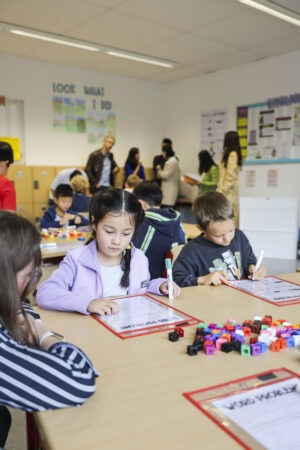
At the same time, their social experience changes. Peers become more important, children’s identities take shape, and their need to feel capable grows. In the classroom, this means that children in grades 5 and 6 learn especially well when they are given responsibility and see that their effort leads to visible results.
For example, when a child in grade 5 takes a weekly math quiz and follows their own progress over several weeks, they experience directly how continuous learning leads to measurable progress. This experience strengthens intrinsic motivation and prepares them for the higher demands of secondary school.
Which Skills Do Children Build in the Bridge Phase?
The bridge phase of grades 5 and 6 targets not only subject content but a broad range of skills that will support students in the long term. These fall into three areas:
- Academic skills: working in a structured way with a school planner and a learning management system, preparing for longer exam formats (up to 120 minutes), and reviewing lesson material independently.
- Study skills: time management, exam preparation, and critical thinking through inquiry-based learning based on Cambridge standards.
- Social and emotional skills: teamwork in an international school community, self-regulation in everyday learning, and building resilience through regular feedback.
These skills are not taught in isolation. They develop through the interplay of classroom routines, peer interaction, and targeted guidance from teachers. As a result, children experience the move to secondary school not as a break but as a natural continuation.
Why Is Early Diagnosis of Learning Gaps Crucial in Grades 5 and 6?
One of the most important lessons in education is that the earlier learning gaps are identified, the more precisely children can be supported. In grades 5 and 6, this is especially important, because gaps that go unnoticed in the bridge phase can quickly turn into bigger problems in secondary school.
A formal assessment plan helps. In grades 5 and 6 at ISR, it includes:
- weekly quizzes (45-minute written tests, alternating between English and math)
- regular tests
- final exams in every subject at the end of each trimester
This structure creates orientation, not pressure. Students know where they stand, and teachers recognize early where targeted support is needed.
In addition, extra academic support in small groups during SEA time (Student Extracurricular Activities) and peer tutoring by older students in grades 11 and 12 provide concrete help before gaps become entrenched. This multi-layered approach ensures that no child falls behind in the bridge phase.
How Can Families See Everyday School Life at ISR?
Families who want to experience ISR International School on the Rhine in person can find information about the campus, the school program, and individual tours at the ISR Info Days.
How Do International Learning Environments Make the Transition Easier?
The move from elementary to secondary school is not only an academic challenge but also a social one. Children change surroundings, meet new classmates, and have to find their way in new structures. An international learning environment can make this process much easier.
In a school community where children from more than 60 nations learn together, adaptability is not the exception but part of everyday life. Students learn early to handle diversity, see things from different perspectives, and work in multicultural teams. These skills are invaluable in secondary school and beyond.
A continuous path from grade 1 to grade 6 within the same school community also offers a decisive advantage. Children know their teachers, trust their surroundings, and enter the next phase with stable relationships. When the move to secondary school comes, it is not a journey into the unknown but a prepared next step on a familiar path.
How Does ISR International School on the Rhine Support the Move to Secondary School?
At ISR, we deliberately designed grades 5 and 6 as a distinct bridge phase that prepares children step by step for the demands of secondary school. Our goal is for every student to master this transition with confidence, solid skills, and a real love of learning.
What sets us apart:
- Structured preparation for secondary school: our formal assessment plan in grades 5 and 6, with weekly quizzes, regular tests, and final exams in every subject, builds the routine needed for secondary school.
- Multilingual education: English as the language of instruction, German as a required subject, and from grade 6 a third language of choice (French, Spanish, Japanese, or Chinese) strengthen communication skills at an international level.
- Individual academic support: small-group support during SEA time and peer tutoring by upper-school students make sure learning gaps are closed early.
- Continuous support for each child’s development: our path from grade 1 to grade 6 at the ISR Elementary School ensures stable relationships between teachers and students and reliable guidance.
- Seamless transition to secondary school: after elementary school, our students continue at the ISR Secondary School on our campus in Neuss, where they are prepared for the Cambridge IGCSE and the International Baccalaureate (IB) Diploma.
- International school community: with students from more than 60 nations, children learn every day to handle diversity and develop global skills that prepare them for universities worldwide.
If you would like to learn more about how we can support your child on the way to secondary school, we look forward to hearing from you.

