An international elementary school is especially suitable for children who grow up in a multilingual, culturally diverse environment and should be prepared early for a global future. This includes children from expat families, multilingual households, and families who want an internationally recognized education for their child. Children do not need perfect English to be admitted, and children without an international background benefit too.
The questions below help you assess whether this path is right for your child.
What Advantages Does an International Elementary School Offer Over a Public School?
An international elementary school offers three main advantages over a public school: multilingual education from the start, an internationally recognized curriculum, and a culturally diverse learning community. Children receive academic support and also develop intercultural skills and open-mindedness early on.
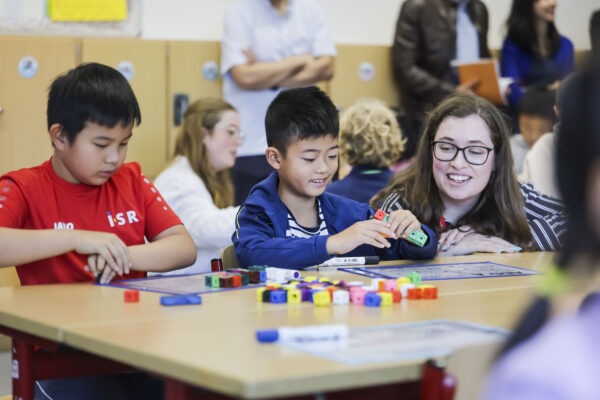
In everyday lessons, this means that English as the main language of instruction, combined with German as a required subject, lays a strong bilingual foundation from the beginning. While public elementary schools in Germany mainly teach in German, children at an international elementary school experience multilingualism as a natural part of school life.
There is also a structured curriculum based on internationally recognized standards such as the Cambridge guidelines. It relies on inquiry-based learning and builds critical thinking, creativity, and personal responsibility. Additional subjects such as music, art, drama, physical education, computer science, and social and emotional learning round out the program. Regular assessment helps identify learning gaps early and respond individually.
Finally, the international school community itself offers unique added value: children learn every day from peers from different cultures and countries, which strengthens their social understanding and empathy for the long term.
Which Children Is an International Elementary School Especially Suitable For?
An international elementary school is especially suitable for children from internationally mobile families and multilingual households, and for children whose parents want a globally oriented education with high academic standards. Children who enjoy languages and cultural diversity also thrive in this environment.
The following children benefit especially:
- Children from expat families: families who move regularly need a curriculum that connects internationally and allows a smooth change of schools.
- Children from multilingual families: children who already speak another language at home find ideal conditions in an English-language school to expand their multilingualism.
- Children interested in languages and other cultures: meeting peers from more than 60 nations makes curiosity and openness a daily experience.
- Children who need an individually adapted learning pace: a structured curriculum with regular assessment and committed teachers makes sure no child is left behind.
- Children aiming to study internationally: those who want to study at a university abroad later lay the crucial foundation with an international elementary education.
Children without a specific international background also benefit: an open-minded, appreciative learning environment strengthens self-confidence, social skills, and the joy of learning in all children.
From What Age Can Children Attend an International School?
Many international schools offer kindergarten programs that gradually introduce children to the language and the learning environment before they start elementary school.
At ISR International School on the Rhine, education starts very early: the international kindergartens in Neuss and Düsseldorf-Niederkassel accept children from age three, while the German-language kindergarten with a bilingual program in Meerbusch-Büderich cares for children from their first year. Elementary school then begins in grade 1 and continues through grade 6.
An early start has clear advantages. Children who come into contact with English in kindergarten develop a natural feel for the language and get used to the international school environment through play. This makes the move into grade 1 much easier, and children start school with a solid language foundation.
How Can Families See Everyday School Life at ISR?
Families who want to experience ISR International School on the Rhine in person can find information about the campus, the school program, and individual tours at the ISR Info Days.
Does My Child Need to Speak English to Be Admitted?
No, your child does not need perfect English to be admitted to an international elementary school. Many international schools, including ISR, admit children at different language levels and support them in acquiring the language.
What matters is the child’s willingness to engage with a new language and a new environment. Young children are especially receptive and learn languages remarkably quickly when they learn and live in an English-speaking environment every day. Experience shows that most children quickly get used to the friendly, supportive school environment.
For children who need extra support, academic leaders and counselors work individually with the child and family to find creative and effective solutions. The goal is for every child to settle in at their own pace and feel like a full member of the school community.
How Do International Qualifications Differ From German Qualifications?
International qualifications such as the Cambridge IGCSE or the International Baccalaureate (IB) Diploma are recognized worldwide and open access to universities around the world. They differ from German qualifications mainly in their global connections and their holistic approach to assessment.
This does not mean that international qualifications rule out the German educational path. On the contrary: at ISR, students earn the German university entrance qualification (Allgemeine Hochschulreife) together with the IB Diploma. Over the past three years, 100 percent of ISR students who aimed for this achieved both qualifications.
The path looks like this:
- Grades 9 and 10: preparation for the Cambridge IGCSE, an internationally respected exam system.
- Grades 11 and 12: the International Baccalaureate Diploma, which at ISR is often even completed bilingually.
- Result: ISR graduates hold two high-quality qualifications that open doors to leading universities in Europe, the Americas, Asia, and beyond.
For families who want to stay in Germany long term, this is especially valuable: their child keeps all options open, for German as well as international universities.
What Should Parents Look For When Choosing an International Elementary School?
Parents should look above all at the school’s accreditation, the quality of the curriculum, teacher qualifications, and the care offered. A reputable international school holds recognized certifications and can show concrete student results.
These criteria help with the decision:
- Accreditation and memberships: is the school certified by recognized organizations such as Cognia, Cambridge, or the Council of International Schools (CIS)? These certificates show that the school meets internationally recognized standards.
- Curriculum: do lessons follow a structured, internationally recognized program? Is multilingualism actively encouraged?
- Teachers and care: are the teachers highly qualified and experienced in international schools? Is there individual support and a well-being team?
- School community: how diverse is the student body? A truly international community enriches daily learning and builds intercultural skills.
- Continuity: does the school offer a continuous path from kindergarten to graduation? Continuity strengthens social and academic development.
- Transparency and communication: are parents informed regularly and openly about grades, homework, and school development?
A campus visit and a personal conversation with the admissions team help you get a realistic picture of the school community and everyday life before you decide.
How Does ISR International School on the Rhine Support Your Child?
We know that choosing the right elementary school is one of the most important decisions parents make for their child. At ISR International School on the Rhine in Neuss, near Düsseldorf, Germany, we combine academic excellence with a warm, supportive school community that puts each child at the center.
What we offer your child:
- a structured, internationally recognized curriculum based on Cambridge standards, with inquiry-based learning and modern methods such as Talk for Writing and White Rose Maths
- bilingual lessons in English and German from the start, plus a third language from grade 6
- highly qualified teachers and a committed support team with a well-being counselor and a school nurse for holistic care
- weekly assessments that identify learning gaps early and allow individual support
- all-day care from 7:30 a.m. to 6:00 p.m. at no extra cost and a varied afternoon program
- an international school community with students from more than 60 nations that actively celebrates cultural diversity
- a continuous path from kindergarten to the IB Diploma with proven top results
Our ISR Elementary School is the foundation for a strong academic career that prepares your child for the future. We warmly invite you to get to know us in person and find out together whether the elementary school at ISR International School on the Rhine is the right place for your child.

