Inquiry-based learning is a teaching approach in which children do not passively absorb knowledge but actively ask their own questions, develop hypotheses, and find answers through observation and exploration. In elementary school, it creates a learning environment in which curiosity drives lessons. It usually follows four phases: asking questions, exploring, evaluating findings, and communicating results.
The sections below explain how inquiry-based learning works in everyday elementary school, what benefits it offers, and how you can recognize a school that truly practices it.
How Does Inquiry-Based Learning Differ From Traditional Teaching?
The key difference lies in the child’s role. In inquiry-based learning, the child actively shapes their own learning, while in traditional teaching they mainly receive content. Instead of ready-made answers, open questions start every unit.
In a traditional lecture-style lesson, the teacher explains a concept, students listen, practice tasks, and are then tested. Inquiry-based learning reverses this: children observe a phenomenon, form their own assumptions, and look for explanations together. The teacher acts as a learning guide who stimulates thinking with targeted questions instead of presenting finished solutions.
Another important difference concerns mistakes. In inquiry-based learning, errors and detours are part of the process, because they show that a child is thinking actively and testing connections. In traditional teaching, mistakes are often seen as a deficit. Inquiry-based learning in elementary school therefore builds not only subject knowledge but also perseverance, critical thinking, and self-confidence.
Which Phases Does Inquiry-Based Learning Go Through in Elementary School?
In elementary school, inquiry-based learning follows a structured process, usually divided into four core phases: asking questions, exploring and investigating, evaluating findings, and communicating results. This cycle can take place within one lesson or extend over several weeks.
- Asking questions: it starts with a phenomenon, picture, experiment, or text that sparks curiosity. Children formulate their own questions about what they do not yet understand or want to know.
- Exploring and investigating: students gather information through observation, experiments, research, or conversations. They develop hypotheses and test them actively.
- Evaluating findings: the data and observations are compared, sorted, and questioned. Was the original assumption right? What did we find out?
- Communicating results: children present their findings as a poster, presentation, model, or class discussion.
These phases are not strictly separate. In everyday school, they flow into each other, and children often return to earlier phases when new questions come up. This is exactly what makes inquiry-based learning so valuable: it mirrors real thinking processes.
Which Subjects Are Especially Suitable for Inquiry-Based Learning?
Inquiry-based learning can be used in almost every elementary subject, but it works especially well in science, social studies, and language lessons, because these subjects naturally offer many open questions and real phenomena that children can explore directly.
In science, inquiry-based learning is almost a given: children observe how plants grow, investigate why objects float or sink, or experiment with simple chemical reactions. The cycle of hypothesis, experiment, and evaluation reflects real scientific methods.
In language lessons, in English as well as in German, children can analyze texts, discover patterns in language, or examine stories from different perspectives. Math also offers many opportunities: instead of memorizing formulas, children explore geometric shapes, discover patterns in number sequences, or solve real-world problems. Social studies topics such as cultures, history, or the environment are especially good for doing their own research and comparing different sources.
What Are the Benefits of Inquiry-Based Learning for Elementary School Children?
Inquiry-based learning strengthens not only subject knowledge but above all cross-curricular skills such as critical thinking, problem solving, communication, and personal responsibility. Children taught this way engage more deeply and lastingly with what they learn.
Because children pursue their own questions, intrinsic motivation develops that reaches far beyond the lesson. They learn not for a grade but because they really want to know how something works. This attitude is a crucial foundation for lifelong learning.
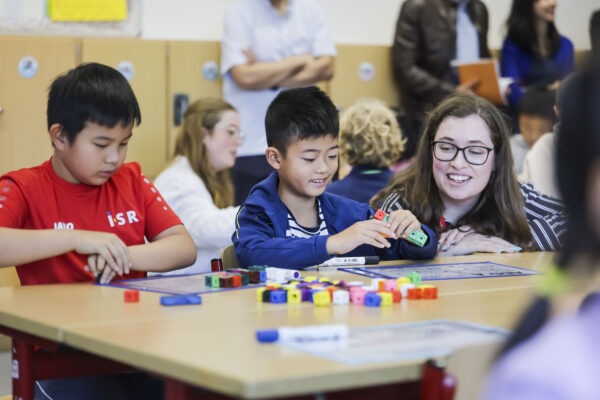
Inquiry-based learning also builds social skills: children often work in groups, discuss their hypotheses, listen to each other, and learn to respect different perspectives. In international learning environments, where children from many cultures come together, this collaborative approach is especially powerful. Self-organization and perseverance are also trained, because children plan, research, and document results on their own.
How Can Parents Support Inquiry-Based Learning at Home?
Parents can best support inquiry-based learning at home by creating an atmosphere that welcomes questions: show real interest in your child’s questions, and instead of answering right away, ask what your child thinks.
For example, when your child asks why the sky is blue, don’t just give an explanation; find out together. Look through books, do small experiments in the kitchen, or observe animals and plants in the garden. The key is to accompany the process of exploring rather than giving away the result.
Helpful habits at home:
- take your child’s questions seriously and research them together instead of giving answers right away
- introduce books, nonfiction, and documentaries as sources of information
- turn everyday phenomena into small experiments, for example while cooking, gardening, or observing nature
- look through the school planner and assignments together regularly to show interest in the inquiry process at school
- celebrate mistakes as part of learning instead of treating them as failures
Parents who show a curious, open attitude themselves are the strongest support for children who experience inquiry-based learning at school.
How Can You Recognize a School That Takes Inquiry-Based Learning Seriously?
You can recognize a school that takes inquiry-based learning seriously by the fact that questions in class are treated as a starting point, not a disruption. Visible signs include open learning spaces, project-based units, work designed by the students themselves, and teachers who act as learning guides.
During a school visit or information session, look for the following:
- Are projects and independent research described as a regular part of the curriculum?
- Is there work that children have developed themselves, such as presentations, models, or exhibitions?
- How do teachers describe their own role in the classroom?
- Are mistakes and detours in learning explicitly welcome?
- Are international curricula such as the Cambridge standards used, which build inquiry-based learning into their structure?
A school that truly practices inquiry-based learning can answer these questions concretely, with examples from everyday school life. Buzzwords are not enough; what matters is how the method is anchored in daily lessons.
How Can Families See Everyday School Life at ISR?
Families who want to experience ISR International School on the Rhine in person can find information about the campus, the school program, and individual tours at the ISR Info Days.
How Does ISR International School on the Rhine Use Inquiry-Based Learning in Elementary School?
At ISR International School on the Rhine in Neuss, near Düsseldorf, Germany, inquiry-based learning is not an add-on but a basic principle of our entire elementary program. Our international curriculum follows internationally recognized Cambridge standards and consistently relies on inquiry-based learning that invites children to ask questions, discover connections, and dive deeply into topics.
What this means for your children:
- An inquiry-based curriculum: our curriculum is designed to spark curiosity and build critical thinking. Modern methods such as Talk for Writing and White Rose Maths encourage independent and creative thinking.
- A holistic range of subjects: in addition to the core subjects math, English, and German, our program includes science, social studies, art, music, drama, physical education, computer science, and social and emotional learning, all areas in which inquiry-based learning is especially fruitful.
- Individual guidance: our committed teachers accompany each child individually and create an atmosphere in which students feel safe enough to ask questions and test hypotheses.
- Continuous support: our elementary concept from grade 1 to grade 6 ensures reliable guidance in a stable environment that builds and deepens inquiry-based learning over the years.
- An international learning community: with students from more than 60 nations, our children bring different perspectives into shared inquiry every day, an enrichment no textbook contains.
If you would like to learn more about how we use inquiry-based learning every day at the ISR Elementary School, we warmly invite you to contact us directly and get to know our school community.

