The Cambridge Primary curriculum is an internationally recognized elementary program for children aged about 5 to 11 that teaches structured, skills-based learning in core subjects such as English, math, and science. It was developed by Cambridge Assessment International Education and is used by schools worldwide that want to give their students a solid, future-oriented foundation. It corresponds to grades 1 to 6 and is the first stage of a path that can lead to the Cambridge IGCSE and the International Baccalaureate (IB) Diploma.
The sections below answer the most important questions about this curriculum.
Which Age Group Is the Cambridge Primary Curriculum Designed For?
The Cambridge Primary curriculum is aimed at children aged about 5 to 11 and corresponds to grades 1 to 6 of elementary school. It follows directly on from early childhood education and is the first stage of the Cambridge pathway, which leads learners to internationally recognized qualifications.
The curriculum is designed to support children’s cognitive, social, and emotional development. Content and requirements increase continuously and adapt to children’s growing abilities. In the early grades, the focus is on building basic skills in reading, writing, and arithmetic, while the upper elementary grades increasingly develop analytical and critical thinking.
The program is explicitly international and suits children from different language and cultural backgrounds. This makes it especially suitable for international schools where families from many nations come together.
Which Subjects Does the Cambridge Primary Curriculum Include?
The Cambridge Primary curriculum includes the core subjects English, math, and science, as well as other subjects such as social studies, art, music, physical education, and computer science. International schools often add further languages and subjects such as drama or social and emotional learning.
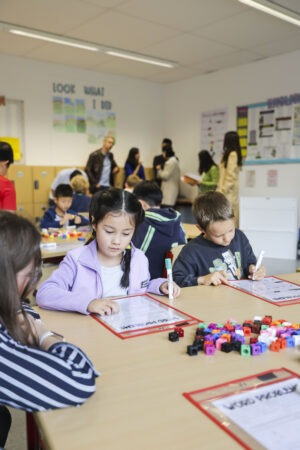
At ISR International School on the Rhine in Neuss, near Düsseldorf, Germany, math, English, and German form the academic core of the elementary program. Both languages are taught at different levels matched to each student’s language skills. Children also have weekly lessons in music, art, physical education, computer science, and social and emotional learning.
Drama is added from grade 3, and students begin a third language in grade 6, choosing from Spanish, French, Japanese, or Chinese (Mandarin). Modern teaching methods such as Talk for Writing and White Rose Maths enrich lessons and encourage independent, creative, and critical thinking.
How Does the Cambridge Primary Curriculum Differ From the German Curriculum?
The main differences are the international focus and the language of instruction. The German elementary curriculum is based on national educational standards and the German language, while the Cambridge Primary curriculum takes a globally oriented, English-language approach that prepares children for an educational path anywhere in the world.
The Cambridge program places special emphasis on inquiry-based learning, critical thinking, and cross-curricular skills. Students do not just receive knowledge; they learn to analyze information, solve problems, and draw their own conclusions. This differs from the more teacher-centered, curriculum-bound teaching common in many German schools.
Another difference concerns assessment. The Cambridge Primary curriculum includes regular formative assessments that track progress continuously, instead of relying only on semester or end-of-year report cards. At the same time, a Cambridge school in Germany does not exclude learning German but includes it as a required subject, so students remain competent both internationally and locally.
What Is the Cambridge Primary Checkpoint?
The Cambridge Primary Checkpoint is an external exam at the end of the primary stage, developed by Cambridge Assessment International Education. It is usually taken in grade 6 and assesses students’ performance in English, math, and science against internationally comparable standards.
The exam serves mainly as a diagnostic tool. It gives teachers, parents, and students a clear picture of current achievement and shows where further development is needed. The Checkpoint also marks the transition to secondary school and prepares learners for more demanding programs such as Cambridge Lower Secondary.
For internationally mobile families, the Cambridge Primary Checkpoint has special value: the results are recognized worldwide and allow a smooth move between Cambridge schools in different countries, without learning gaps or the need to re-evaluate school records.
How Can Families See Everyday School Life at ISR?
Families who want to experience ISR International School on the Rhine in person can find information about the campus, the school program, and individual tours at the ISR Info Days.
How Does the Cambridge Primary Curriculum Prepare Children for Secondary Qualifications?
The Cambridge Primary curriculum is the first building block of a continuous international pathway that leads directly to Cambridge Lower Secondary, the Cambridge IGCSE, and finally the International Baccalaureate Diploma. The skills developed in the elementary program form the foundation for all later academic demands.
Early development of learning strategies, self-organization, and analytical thinking is especially important. Students who have completed the Cambridge Primary curriculum bring demonstrably better conditions for independent work and critical thinking to secondary school. These skills are essential for demanding programs such as the IGCSE or the IB Diploma.
The transition between stages is clearly structured. In grades 5 and 6, assessment becomes deliberately more formal to prepare students gradually for secondary exam formats. Weekly assessments help identify and close learning gaps early, before they have a negative effect in secondary school.
How Can You Recognize an Accredited Cambridge School?
An accredited Cambridge school is officially recognized by Cambridge Assessment International Education as a Cambridge Examination Centre or Cambridge school. This means the school meets verified quality standards in teaching, assessment, and school development and is authorized to administer official Cambridge exams.
Accredited schools undergo regular external quality reviews and commit to continuously developing their programs. Membership in the Cambridge network is not a one-time status but an ongoing process that keeps schools’ teaching quality at a high level.
In addition to Cambridge accreditation, schools can hold other international certifications that confirm their quality, such as membership in Cognia or the Council of International Schools (CIS), or recognition as an IB World School. Several independent accreditations are a reliable sign of a school with proven international quality standards.
How Does ISR International School on the Rhine Deliver the Cambridge Primary Curriculum?
At ISR, we offer an elementary program fully embedded in the Cambridge framework that strengthens children academically and personally. Our approach combines international standards with a warm, supportive school community in which every child is at the center.
- A Cambridge-accredited curriculum: we are a recognized Cambridge Examination Centre and implement the Cambridge Primary curriculum consistently in all elementary grades, complemented by modern methods such as Talk for Writing and White Rose Maths.
- Multilingual education: English as the language of instruction, German as a required subject, and a third language from grade 6 prepare our students for a global future.
- Regular assessment: weekly tests and structured assessment cycles allow us to identify and close learning gaps early and individually.
- Academic support: extra support lessons, peer tutoring by students in grades 11 and 12, and a committed team of teachers make sure no child falls behind.
- A seamless educational path: our ISR Elementary School prepares students for the move to secondary school, where the Cambridge IGCSE and the IB Diploma await them.
- An international school community: with more than 60 nationalities on campus, children experience diversity firsthand and develop intercultural skills as a natural part of school life.
To learn more about our secondary program, visit the ISR Secondary School, where our graduates continue on to renowned universities worldwide.

