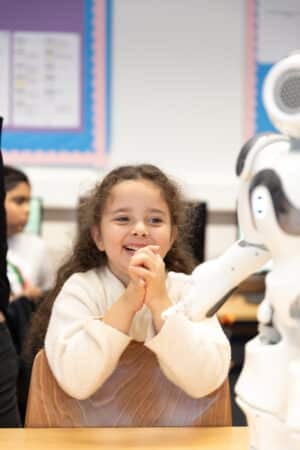
In 2026, international schools in Germany use digital whiteboards, e-books, virtual reality (VR) headsets, 3D printers, artificial intelligence (AI)-powered learning tools, and web-based platforms for real-time feedback. Technology-based learning methods at international schools have long since moved beyond laptops in the classroom. Schools use these tools deliberately to support students individually, identify learning gaps early, and prepare them for an increasingly digital world.
What Exactly Are Technology-Based Learning Methods at International Schools?
Technology-based learning methods are all approaches in which digital tools actively support teaching. This starts with simple things like interactive whiteboards that replace chalkboards and extends to virtual reality, which lets students literally experience historical events or scientific phenomena.
The important thing is this: technology does not replace good teachers or a structured curriculum. It complements both. A well-trained teacher who meaningfully integrates a VR headset into a history lesson creates a learning experience that sticks, and that is exactly the difference between technology as a toy and technology as a genuine learning tool.
Which Digital Technologies Are International Schools Using in 2026, and What For?
The range is broad and grows every year. The technologies most commonly used at international schools in Germany today include:
- Interactive whiteboards: They replace traditional chalkboards and enable multimedia lessons with videos, diagrams, and live research.
- E-books and digital libraries: Students have access to hundreds of titles without having to carry heavy backpacks.
- Virtual reality headsets: For subjects such as history, geography, or the sciences, VR experiences offer direct access to content that is difficult to convey in the classroom.
- 3D printers: Especially in STEM subjects, students can bring their own ideas to life and apply technical thinking in practice.
- Web-based learning platforms: Parents and teachers can view learning progress in real time and respond together when support is needed.
- AI-powered learning tools: Adaptive systems tailor tasks and content to each student’s individual pace of learning.
What these technologies have in common: they work best when they are embedded in a clear educational concept, not when they are simply available.
How Does the Use of Technology Differ Between International and Public Schools?
Public schools in Germany have made considerable progress in recent years, especially through the Digital Pact for Schools (DigitalPakt Schule). Nevertheless, there are structural differences compared with international private schools that have a direct impact on everyday classroom life.
International schools often have more modern equipment because they can reinvest income directly and do not have to go through bureaucratic procurement processes. In addition, their curricula are often designed for digital integration from the start, for example through international curricula such as the International Baccalaureate (IB), which firmly embeds critical thinking and independent research.
Another difference lies in the speed of adaptation. International schools can introduce and test new tools more quickly because they are more flexible in their decision-making. This does not mean that public schools are worse, but the framework in which they operate is different.
How Does Technology-Supported Learning Foster Children’s Individual Strengths?
Every child learns differently. Some understand math better through visual representations, others through practical tasks. Technology-supported learning offers real advantages here because it opens up more paths to the same goal.
Adaptive learning platforms, for example, recognize where a child is having difficulty and automatically adjust the next set of tasks. At the same time, teachers receive data showing them where a student needs more support. This is more efficient than the traditional model, in which gaps often only become visible at the next exam.
Weekly progress checks combined with digital feedback allow teachers to intervene early. The result: children who want to move ahead faster are not held back, and children who need more time do not fall through the cracks.
What Role Do VR and AI Play in International School Classrooms?
In 2026, virtual reality and artificial intelligence are no longer a thing of the future but an active part of everyday school life at well-equipped international schools.
VR enables learning experiences that would simply not be possible with traditional means. Students can:
- explore ancient Rome
- look at the solar system from the inside
- analyze chemical molecules in three dimensions
This not only increases interest but also deepens understanding, because abstract concepts suddenly become tangible.
In the classroom, AI mainly takes on supporting tasks: it helps personalize learning paths, evaluate learning progress, and prepare for exams. At the same time, students learn how to use AI responsibly and critically, a skill that is increasingly in demand on the job market.
It is important that AI and VR are used as a complement, not as a substitute for deep thinking, discussion, and writing one’s own texts. Schools that understand this use technology where it genuinely helps.
What Should Parents Look for in a School’s Use of Technology?
If you are looking for an international school for your child, it is worth taking a closer look at the topic of technology. Modern equipment alone says little. What matters is how it is used.
Here are some questions you can ask on your next school visit:
- Is technology integrated into the curriculum? Or is there a computer room that is only used once a week?
- Is there a concept for digital literacy? Do students learn not only to work with technology but also to use it critically?
- How are parents involved? Web-based platforms that provide real-time feedback on learning progress are a good sign of transparent communication.
- Are learning gaps actively identified? Regular progress checks combined with digital tools help identify and resolve problems early.
- Is the technology up to date? VR headsets, 3D printers, and modern IT rooms show that a school invests in its learning environment.
Technology is a tool, not an end in itself. Schools that understand this create a learning environment in which children do not just absorb content but learn to think, research, and create for themselves.
How Does ISR International School on the Rhine Support Technology-Based Learning?
At ISR International School on the Rhine in Neuss, near Düsseldorf, Germany, we believe that modern technology delivers its greatest added value when it is used purposefully and in an educationally sound way. We have therefore created a learning environment in which digital tools are firmly integrated into everyday teaching, always with the child at the center, from the early years through the IB Diploma Programme at ISR.
- VR headsets and 3D printers allow our students to experience abstract content in STEM subjects, history, and the sciences up close and apply it in practice.
- More than 500 digital e-books and interactive whiteboards in every classroom ensure modern, media-rich teaching without unnecessary baggage.
- AI-supported learning approaches help us identify individual learning progress early and provide targeted support, so that no child falls behind.
- Web-based platforms keep parents informed about their child’s learning progress transparently and in real time.
- International curricula such as the International General Certificate of Secondary Education (IGCSE) and the International Baccalaureate Diploma structurally embed digital literacy and critical thinking in the curriculum.
If you would like to see for yourself how we meaningfully integrate technology into everyday school life, we look forward to meeting you in person. Feel free to attend one of the ISR Info Days and experience our campus and our approach to learning firsthand.

