Choosing the right elementary school for your child means finding a school that fits your child’s learning style and needs as well as your family’s values and long-term educational goals. Key factors include teaching quality, school climate, the educational approach, and the path your child will take after elementary school. Ideally, start your search about six to nine months before the desired start date.
The sections below answer the most important questions about choosing an elementary school.
Which Criteria Really Matter When Choosing an Elementary School?
The most important criteria are teaching quality, school climate, educational approach, and how well the school fits your family’s situation. No single feature decides on its own; what counts is the combination of academic standards, social atmosphere, and practical factors such as location and school hours.
Check the following points:
- Teaching quality and curriculum: how structured is the curriculum? Are there regular assessments that identify learning gaps early?
- Class size and individual support: do teachers have enough time to respond to individual children?
- School climate and community: does your child feel welcome during the visit? Are responsibility and social learning actively encouraged?
- Future prospects: which secondary schools and qualifications follow?
- Practical conditions: the way to school, after-school care, and communication with parents.
Take the time to visit schools in person. A campus visit gives you a much clearer picture than any brochure.
What Is the Difference Between a Public and a Private Elementary School?
The main differences between public and private elementary schools are funding, educational approach, and admissions. Public elementary schools are free and follow the curriculum of their German state. Private elementary schools charge tuition but have more freedom in designing their curriculum, choosing the language of instruction, and shaping their school community.
Private schools, especially international ones, can often offer specialized programs that are not available in the public system, such as English-language instruction, international qualifications, or a particularly structured assessment system. In return, attending a private school requires an active application, and places are limited.
For families who are internationally mobile, have multilingual children, or want an internationally recognized educational path, a private international elementary school often offers clear advantages. For children who are firmly rooted in a region and have no special language or curriculum needs, a public school can be the right choice.
When Should You Start Looking for an Elementary School?
Ideally, start your search toward the end of winter or at the beginning of spring for the coming school year, about six to nine months before the desired start date. At private and international schools, an early start is especially important, because admission depends on available places.
Many families underestimate how quickly places fill up, especially in popular locations such as Neuss and Düsseldorf. As a rule, the earlier you start researching, the more options you have. Keep in mind that the admissions process at private schools can involve several steps, including application forms, school visits, and meetings with the school leadership.
Good to know: many international schools also admit new students during the school year. If your family is moving at short notice or your situation changes, it is still worth getting in touch directly.
How Can Families See Everyday School Life at ISR?
Families who want to experience ISR International School on the Rhine in person can find information about the campus, the school program, and individual tours at the ISR Info Days.
How Can You Recognize a High-Quality Elementary School?
A high-quality elementary school has a structured, transparent curriculum, qualified and committed teachers, a positive learning environment, and demonstrable student achievement. Accreditation and membership in recognized educational organizations are further reliable indicators of quality.
Look for the following features:
- Accreditation: is the school certified by recognized national or international educational organizations?
- Regular assessment: is progress tracked systematically, and are learning gaps identified early?
- Transparent communication: are parents informed regularly and clearly about grades, homework, and school developments?
- Holistic support: does the school offer music, sports, art, computer science, and social learning in addition to core subjects?
- Settling-in concept: how are new children welcomed and integrated into the community?
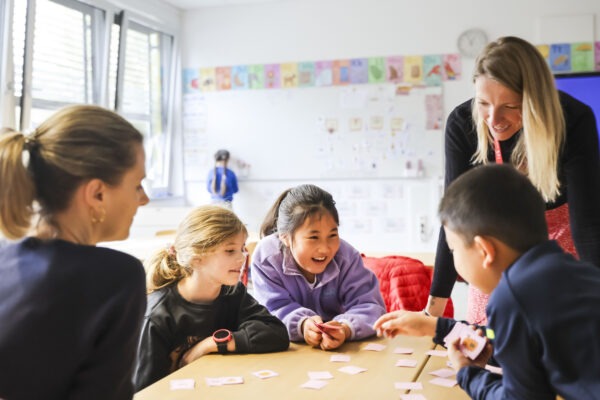
Visit the school in person and observe the atmosphere. A school where children are visibly happy, teachers are attentive and friendly, and clear structures are noticeable is a strong sign of real quality.
What Role Does the Language of Instruction Play?
The language of instruction is a central criterion, especially for families with an international background, plans to move abroad, or the wish for a multilingual education. Children taught in several languages during elementary school often develop strong cognitive flexibility and better communication skills.
At an international elementary school with English as the main language of instruction and German as a required subject, children build solid skills in both languages from the start. This is especially valuable if the family is internationally mobile or the child later wants to study at an English-speaking university.
German-speaking families who plan to stay in Germany long term often ask whether English as the language of instruction makes it harder to integrate into the German school system. In practice, well-structured international schools treat German as a full subject, and children have no trouble continuing on to secondary education in Germany.
How Does an International Elementary School Prepare Children for Secondary School?
An international elementary school prepares children for secondary school through a structured, demanding curriculum, multilingual skill development, and increasingly formal assessment. The focus is not only on academic achievement but also on children’s social and emotional maturity.
In the upper elementary grades, assessment formats gradually become more demanding. Weekly tests, trimester exams, and project-based assessments get children used to the demands of secondary school early on. At the same time, a continuous path from grade 1 to grade 6 fosters stable relationships and reliable guidance that strengthen both cognitive and social development.
Another advantage of international elementary schools is the preparation for internationally recognized qualifications. Children who finish elementary school with solid skills in English and German and a structured way of learning are well equipped for secondary school, whether at a national or an international school.
How Does ISR International School on the Rhine Help Parents Choose an Elementary School?
We know that choosing the right elementary school is one of the most important decisions parents make. At ISR International School on the Rhine in Neuss, near Düsseldorf, Germany, we designed our ISR Elementary School to answer exactly the questions parents have when choosing a school. What sets us apart:
- A structured, internationally recognized curriculum: our curriculum combines English-language instruction with German as a required subject and prepares children for international qualifications such as the Cambridge IGCSE and the International Baccalaureate (IB) Diploma.
- Early identification of learning gaps: weekly assessments ensure that no child falls behind and that every student receives individual support.
- A warm, supportive start: new children are welcomed by student ambassadors from their class, receive a personal introduction to the campus, and are part of our community from day one.
- Holistic education: in addition to the core subjects, we offer music, art, physical education, computer science, drama, and social and emotional learning, because we believe strong characters and good grades belong together.
- Transparent communication with parents: through our ISR app and regular newsletters, you are always informed about homework, grades, and school events.
- A clear path to university: after elementary school, our students continue at the ISR Secondary School, where they can earn two internationally respected qualifications, the IB Diploma and the ISR High School Diploma.
If you would like to find out whether ISR is the right elementary school for your child, we warmly invite you to visit our campus in Neuss. Simply make an appointment with our admissions team and experience our international school community in person.

