Between grade 1 and grade 6, children move from concrete, hands-on learning to abstract thinking and increasingly independent study. In grades 1 to 3, they learn best by seeing, touching, and trying things out; in grades 4 to 6, they plan complex tasks on their own, develop learning strategies, and get used to formal exams. An international elementary school adds daily experience with several languages and cultures, which builds empathy, flexibility, and self-confidence.
The elementary years are among the most formative in a child’s life. In just six years, not only a child’s knowledge changes but also the way they think, learn, communicate, and get along with others. This article walks you step by step through the stages of development from grade 1 to grade 6 at an international elementary school.
What Really Happens to a Child During the Elementary School Years?
Elementary school is much more than the time when children learn to read, write, and do arithmetic. It is a fundamental stage of development in which cognitive, social, emotional, and language skills grow at the same time and influence each other.
Children start school with a strong urge to understand the world. This natural spirit of discovery drives everything that happens in elementary school. A learning environment that takes up this drive and channels it in a structured way lays the foundation for lasting success at school.
A common misconception is that development is linear: first reading, then writing, then math. In reality, these areas develop in parallel and depend on each other. A child who can talk about their thoughts understands math concepts faster. A child who feels safe dares to ask more questions. That is why children’s development at school should always be seen holistically.
How Do Learning and Thinking Change in Grades 1 to 3?
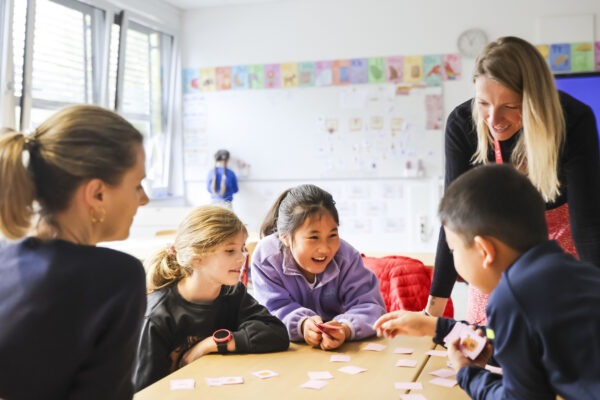
In the first three school years, the concrete comes first. Children at this age learn best by seeing, touching, trying, and repeating. Abstract concepts only make sense to them when illustrated with tangible examples.
In grade 1, children begin to connect letters with sounds and understand simple arithmetic. In grades 2 and 3, their ability to make connections grows: a child no longer just knows that 3 plus 4 equals 7 but begins to understand why and how to apply this knowledge in other situations.
At the same time, working memory develops. Children can increasingly remember longer instructions, carry out several steps in a row, and do simple planning. For teachers, this means the way tasks are set is crucial during this period.
- Grade 1: basic reading and writing skills, understanding numbers up to 20, first sentence structures
- Grade 2: growing reading comprehension, simple written expression, the four basic operations
- Grade 3: understanding texts, first essays, multiplication and division, beginning logical thinking
For example, while a first grader still counts to find out how many apples are in two baskets, a third grader already calculates in their head and explains their reasoning. This change in thinking is a sign of growing cognitive maturity, not just more practice.
What Can Children Do Independently in Grades 4 to 6?
Grade 4 marks a new phase. Children are now able to plan and carry out more complex tasks independently. Their thinking becomes increasingly abstract: they can form hypotheses, draw conclusions, and look at issues from different perspectives.
Building on the foundations of the first three years, children in this phase develop real learning strategies. They notice which methods work for them, how to divide up material, and how to deal with mistakes. This metacognition, thinking about one’s own thinking, is a decisive step toward self-directed learning.
In grades 5 and 6, exam formats become more demanding. At an international elementary school such as ISR International School on the Rhine in Neuss, near Düsseldorf, Germany, students take final exams in every subject from grade 5, lasting between 90 and 120 minutes. This builds not only subject knowledge but also concentration, time management, and resilience.
- Grade 4: reading and summarizing independently, peer tutoring as a way of learning, structured writing
- Grade 5: cross-curricular thinking, subject exams, a growing sense of responsibility
- Grade 6: independent project work, introduction of a third language, preparation for secondary school
From grade 6, students at ISR begin a third language, choosing from Spanish, French, Japanese, or Chinese (Mandarin). This early expansion strengthens not only language skills but also cultural awareness and cognitive flexibility.
How Does an International Environment Shape Personal Development?
An international school environment is not just a feature; it is an active part of personal development. Children who work every day with classmates from different cultures and language backgrounds develop empathy, openness, and communicative flexibility in a way that is harder to achieve in a monocultural environment.
In practice, children learn early that there are different ways to solve a problem, tell a story, or express an opinion. This insight sharpens critical thinking and makes children more adaptable.
There is also an emotional dimension. At an international school, many children are newcomers themselves or know the feeling of arriving in a new environment. This creates a natural culture of mutual understanding. Classroom roles that rotate regularly, such as group leader, taking attendance, or handing out books, further strengthen each child’s sense of responsibility and self-confidence.
At an international elementary school, social and emotional learning is not an add-on but a fixed part of everyday school life. Children learn to resolve conflicts, name their feelings, and act as part of a community made up of more than 60 nationalities.
How Can Families See Everyday School Life at ISR?
Families who want to experience ISR International School on the Rhine in person can find information about the campus, the school program, and individual tours at the ISR Info Days.
What Do Children Bring With Them When They Start Grade 7?
The move from elementary to secondary school is a significant step. Children who have gone through grades 1 to 6 at an international elementary school bring a broad foundation that goes far beyond subject knowledge.
Academically, they have solid English and German, first experience with a third language, and a structured understanding of math, science, social studies, and other subjects. Methods such as Talk for Writing and White Rose Maths have built not only subject knowledge but also independent, creative, and critical thinking.
Personally, these children start with a clear advantage: they know themselves as learners. They know how to deal with challenges, how to ask for help, and how to work in an international team. This combination of academic preparation and personal maturity is the real goal of a good international elementary education.
- multilingual communication as daily practice
- experience with formal exam formats and time management
- intercultural skills through diversity lived every day
- independent learning through peer tutoring and classroom roles
- strong foundations in core subjects, supported by regular assessment
In short, children who have attended an international elementary school start grade 7 not only with more knowledge but with more tools to use and develop that knowledge.
How Does ISR International School on the Rhine Support Your Child From Grade 1 to Grade 6?
At ISR, we understand that the elementary years set the course for everything that follows. That is why we designed our ISR Elementary School so that every child receives individual support while being part of a lively international community. Our program combines academic excellence with holistic personal development so your child is well prepared for secondary school and beyond.
What we offer your child during the elementary years:
- A structured Cambridge curriculum: inquiry-based learning based on internationally recognized standards that sparks curiosity and builds deep understanding
- Bilingual instruction: English as the language of instruction combined with German as a required subject, plus a third language of choice from grade 6
- Individual academic support: small support groups during SEA time (Student Extracurricular Activities) and peer tutoring by upper-school students from grade 4
- Holistic care: care from 7:30 a.m. to 6:00 p.m. at no extra cost, complemented by a varied afternoon program
- Well-being in everyday school life: specialized well-being counselors support each child’s social and emotional development
- Modern teaching methods: approaches such as Talk for Writing and White Rose Maths build independent, creative, and critical thinking from the start
- An international school community: more than 60 nationalities on campus make intercultural learning part of daily life
If you would like to learn more about how we accompany your child through the elementary years and into the ISR Secondary School, we look forward to hearing from you. Together we can find out whether ISR is the right choice for your family.

