The Cambridge curriculum is an international educational framework, developed by Cambridge Assessment International Education, that sets clear learning goals, skill levels, and assessment standards and is used in more than 160 countries. In elementary school, its Cambridge Primary stage covers grades 1 to 6 and uses an inquiry-based approach: children are encouraged to ask questions, recognize connections, and think independently rather than simply receive knowledge.
Many parents looking for an international school come across the term Cambridge curriculum for the first time and wonder what it means for their child’s everyday school life. This article explains how the Cambridge curriculum is structured, how it shapes lessons in elementary school, and how it differs from national curricula.
What Is the Cambridge Curriculum and How Is It Structured?
The Cambridge curriculum is an international educational framework developed by Cambridge Assessment International Education (formerly University of Cambridge International Examinations). It defines clear learning goals, skill levels, and assessment standards that are used in more than 160 countries worldwide.
Its structure follows a logical progression through different stages. The stage relevant to elementary school is called Cambridge Primary and covers grades 1 to 6. It is followed by Cambridge Lower Secondary (grades 7 to 9) and Cambridge Upper Secondary with the well-known IGCSE qualification. Each stage builds systematically on the previous one, so children are never confronted with a jump into a new system but keep developing continuously.
A central feature of this curriculum is its inquiry-based approach. Children are not just given knowledge but are encouraged to ask questions, recognize connections, and think for themselves. For example, instead of explaining to a child why plants need light, the Cambridge curriculum has the child carry out an experiment, observe, and draw their own conclusions.
How Does the Cambridge Curriculum Shape Lessons in Elementary School?
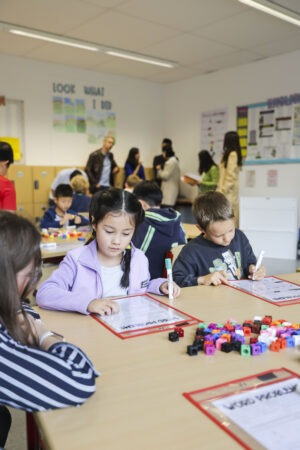
In elementary school, the Cambridge curriculum shows in a clearly structured but lively school day. Lessons are designed to inspire children, spark their curiosity, and foster a deep love of learning, rather than overwhelm them with facts.
Modern methods are used. In English, for example, the Talk for Writing method introduces children to writing through oral storytelling first. In math, White Rose Maths builds mathematical understanding step by step and visually before abstract formulas are introduced. These methods are not extras but an integral part of the Cambridge approach.
Social and emotional learning is also a fixed part of the timetable. Children develop not only academic skills but also a sense of responsibility, for example through rotating classroom roles such as group leader or taking attendance. This creates a learning environment in which every child feels safe and empowered.
How Can Families See Everyday School Life at ISR?
Families who want to experience ISR International School on the Rhine in person can find information about the campus, the school program, and individual tours at the ISR Info Days.
Which Core Subjects and Learning Goals Does the Program Include?
At ISR International School on the Rhine in Neuss, near Düsseldorf, Germany, the Cambridge Primary program is built around three core subjects: math, English, and German. They form the academic foundation for all other subjects. Both languages are taught at different levels, matched to each child’s language development.
The core program is complemented by a wide range of other subjects:
- Science and social studies
- Art and music
- Drama from grade 3
- Physical education and computer science
- Social and emotional learning (SEL)
- weekly library visits
A third language is added from grade 6. Students can choose Spanish, French, Japanese, or Chinese (Mandarin). In the third language, too, the focus is on reading comprehension, vocabulary, grammar, spoken communication, and cultural awareness, the same skill areas children already know from English and German lessons. This makes transfer easier and strengthens their overall feel for languages.
How Is Progress Measured and How Are Learning Gaps Identified?
The structured Cambridge curriculum includes an equally well-designed assessment system. The aim is not to put children under pressure but to identify learning gaps early and close them.
In grades 1 to 4, children are assessed continuously in all academic subjects. Assessment includes:
- end-of-unit tests
- projects that make skills visible in practice
- final exams at the end of each trimester in the core subjects English, math, German, and science
In grades 5 and 6, the assessment plan becomes more formal to prepare for the move to secondary school. Weekly 45-minute quizzes alternate between English and math, and regular tests last between 45 and 90 minutes. At the end of each term, every student takes a final exam in every subject.
Children who need extra help receive targeted support. Small groups meet during SEA time (Student Extracurricular Activities), when subject teachers review or re-explain specific concepts. From grade 4, students can also benefit from peer tutoring, with older students from grades 11 and 12 acting as tutors.
How Does the Cambridge Curriculum Differ From National Curricula?
A common misconception is that international curricula are less demanding than national ones. The opposite is true. The Cambridge curriculum deliberately aims for global comparability and international connections, which clearly sets it apart from national curricula in several ways.
National curricula are usually geared to their own school system and the local job market. The Cambridge curriculum prepares children for a world in which they can study at universities in Germany, the United Kingdom, the United States, Asia, or elsewhere. Its qualifications are recognized worldwide.
Concrete differences:
- Language skills: children learn in two languages (English and German) from the start and add a third from grade 6, while national elementary schools often start their first foreign language late.
- Inquiry focus: the Cambridge curriculum places special emphasis on critical thinking and independent learning, not just reproducing content.
- International comparability: achievement is measured against global standards, which makes moving between schools and countries much easier.
- Depth of assessment: instead of grades alone, projects, speaking skills, and continuous assessment contribute to the overall picture.
For families who are internationally mobile or want to keep the widest possible range of educational options open for their children, the Cambridge curriculum offers a structural advantage that reaches far beyond elementary school.
How Does ISR International School on the Rhine Use the Cambridge Curriculum?
At ISR, we do not simply implement the Cambridge curriculum; we live it every day in an international school community that brings together children from more than 60 nations. Our ISR Elementary School offers students in grades 1 to 6 a carefully designed, holistic program that builds on the strengths of the Cambridge curriculum and prepares them well for the rest of their school career.
What sets us apart:
- Accredited Cambridge Examination Centre: we are officially accredited and prepare students for internationally recognized Cambridge exams.
- A multilingual learning environment: lessons in English, German as a required subject, and from grade 6 a third language of choice, all in one coherent language program.
- Inquiry-based learning with modern methods: we use proven approaches such as Talk for Writing and White Rose Maths, which anchor the Cambridge principle of independent thinking in everyday lessons.
- Early placement assessments: new students are placed on admission, so lessons match their individual level right away.
- Targeted support: from academic support in small groups to peer tutoring by older students, we make sure no child falls behind.
- A continuous educational path: after elementary school, our students continue seamlessly at the ISR Secondary School, where the Cambridge IGCSE and the International Baccalaureate (IB) Diploma await them.
We believe every child has the potential to achieve great things when supported in the right environment. The Cambridge curriculum offers the ideal foundation for this, and we are proud to bring it to life every day.

