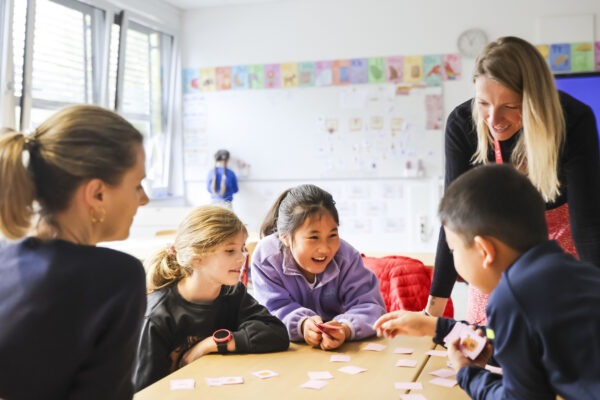
A continuous school model from grade 1 to grade 6 gives children a stable learning environment in which they build academic, social, and emotional foundations without being interrupted by an early change of schools. It strengthens relationships between students and teachers, supports individual learning, and prepares children step by step for secondary school. At ISR International School on the Rhine in Neuss, near Düsseldorf, Germany, the elementary school follows this model.
The questions below explain the most important advantages in detail.
What Do Children Learn in a Continuous School Model From Grade 1 to Grade 6?
In a continuous model from grade 1 to grade 6, children gain subject knowledge while developing study and social skills in a stable environment. The structured design makes it possible to identify and close learning gaps early, before they become entrenched in higher grades.
At ISR, the core curriculum includes math, English, and German, complemented by science, social studies, art, music, drama, physical education, computer science, and social and emotional learning. This breadth ensures holistic support from the start. Modern teaching methods such as Talk for Writing and White Rose Maths encourage independent, creative, and critical thinking.
Drama is added from grade 3, and students begin a third language in grade 6. Organizational skills are also built early: from grade 1, children use a school planner to record tasks and important information. This structured approach prepares them gradually for the higher demands of secondary school.
How Do Children Benefit Socially From Stable Class Communities?
Stable class communities over several years foster deep trust, a strong sense of belonging, and long-term friendships. Children who grow up together with the same classmates over six school years develop social skills more lastingly than in settings where groups are regularly reshuffled.
This stability is especially valuable in an international school community like ISR’s, with students from around 60 nations. Children learn to understand cultural differences, develop empathy, and treat each other with respect. These experiences shape their social behavior far beyond their school years.
Students also take on concrete responsibility in class: roles such as group leader, handing out books, or taking attendance rotate during the school year, so every child gets to know different areas of responsibility. This approach builds self-confidence and a positive sense of community.
How Can Families See Everyday School Life at ISR?
Families who want to experience ISR International School on the Rhine in person can find information about the campus, the school program, and individual tours at the ISR Info Days.
What Are the Disadvantages of Changing Schools After Grade 4?
For many children, changing schools after elementary school is a significant interruption: they have to find their way in a new school culture, make new friends, and get used to different teachers and teaching methods. This adjustment takes time and energy that could otherwise go into learning.
For children who have already moved several times or come from abroad, an additional school change can be especially stressful. Breaking familiar structures can weaken self-confidence and slow academic progress. In a continuous model from grade 1 to grade 6, this break disappears completely.
Instead, children experience a smooth transition within the same school community. Teachers have known each child’s strengths and needs for years, which allows more targeted support. The move to secondary school then happens from a stable base, from which children can approach new challenges with confidence.
How Does a Unified School Model Support Language Development?
A unified school model from grade 1 to grade 6 creates ideal conditions for systematic, step-by-step language development. Children learn English and German from the start at different levels matched to their individual development, without a school change interrupting their progress.
Because teachers know each child’s starting point and accompany them for years, they can address gaps and follow progress over the long term. Lessons focus on reading comprehension, vocabulary, spelling, grammar, speaking, and writing, and both languages are treated as equally important.
A third language is added from grade 6: French, Spanish, Japanese, or Chinese. Children start at a point when they already have strong language skills and can learn the new language on a solid foundation. The cultural awareness this builds complements academic language skills in a valuable way.
What Role Do Teachers Play in a Long-Term School Model?
In a long-term model from grade 1 to grade 6, teachers are much more than conveyors of knowledge. They accompany children over several years, know their individual strengths, learning styles, and personal development, and can support and challenge them accordingly.
This continuity in the relationship between teacher and child has a proven positive effect on the learning climate. Children who trust their teacher are more willing to ask questions, admit mistakes, and take on new challenges. Teachers can also recognize early when a child needs extra support and respond.
In addition to the homeroom teacher, ISR offers academic support: small support groups meet during SEA time (Student Extracurricular Activities), and from grade 4 there are peer tutoring sessions in which older students from grades 11 and 12 support younger children in core subjects such as math, English, and German. This system strengthens both the learners and the tutors.
When Does Such a School Model Begin Preparing for Secondary Qualifications?
Preparation for secondary qualifications begins in grades 5 and 6, when a more formal assessment plan is introduced. Weekly tests in English and math, regular exams, and final exams at the end of each term prepare children step by step for the demands of secondary school.
In grades 1 to 4, core subjects such as English, math, German, and science are assessed through end-of-unit assessments, while project-based learning makes progress visible in other subjects. From grade 5, students take a final exam in every subject lasting between 90 and 120 minutes. This structure gently gets children used to formal exam situations.
Secondary school then leads to preparation for the Cambridge IGCSE in grades 9 and 10 and the International Baccalaureate (IB) Diploma in grades 11 and 12. The strong foundation from elementary school is crucial: students who have learned in a stable, structured environment from grade 1 enter these demanding final stages with confidence and competence.
How Does ISR International School on the Rhine Design Its Continuous Model From Grade 1 to Grade 6?
At ISR, we are convinced that a continuous path from grade 1 to grade 6 lays the best foundation for long-term academic success and personal development. Our model combines structured support with a warm, supportive learning environment in which every child can grow at their own pace. These are the features of our ISR Elementary School:
- Continuous guidance: our teachers accompany children over several years and know their individual strengths and needs firsthand.
- A Cambridge-based, inquiry-based curriculum: our curriculum follows internationally recognized Cambridge standards and builds critical thinking, curiosity, and deep understanding.
- Multilingual support: English and German are taught from the start at individually adapted levels, with a third language added from grade 6.
- A structured assessment system: weekly tests, trimester exams, and formal final exams prepare children step by step for secondary school.
- Targeted academic support: support groups during SEA time and peer tutoring by upper-school students make sure no child falls behind.
- A holistic program: music, art, drama, physical education, computer science, and social and emotional learning complement the core subjects and support personal development.
- A seamless transition to secondary school: after elementary school, our students continue at the ISR Secondary School in Neuss, where they prepare for the Cambridge IGCSE and the IB Diploma.

