Compared with a public school, a private elementary school typically offers smaller classes, a more structured curriculum, and more individualized support for every child. Especially for families who value multilingualism, international qualifications, and close guidance for their children, a private elementary school can make all the difference. The following questions highlight the most important differences and help you make your decision.
What Specifically Sets a Private Elementary School Apart From a Public One?
A private elementary school differs from a public school primarily through its independent curriculum, smaller learning groups, a broader range of subjects, and more individualized attention for students. While public schools are bound by uniform statewide curricula, private schools can set their own educational priorities and integrate internationally recognized programs.
Which Subjects and Assessments Do Private Elementary Schools Offer?
In concrete terms, private elementary schools often place great emphasis on regular assessments in order to identify learning gaps early and close them in a targeted way. In addition to the core academic subjects, children often receive weekly lessons in:
- Music
- Art
- Physical education
- Computer science
- Social and emotional learning
From certain grade levels on, further offerings such as drama or library visits are added. Together, these subjects foster children’s holistic development.
How Involved Are Parents at a Private Elementary School?
Another key difference is parent involvement. Private schools often rely on closer collaboration between teachers, school leadership, and families in order to respond to each child’s individual needs. This creates reliability and transparency, which education-minded parents particularly appreciate.
How Does Class Size Affect Learning Success?
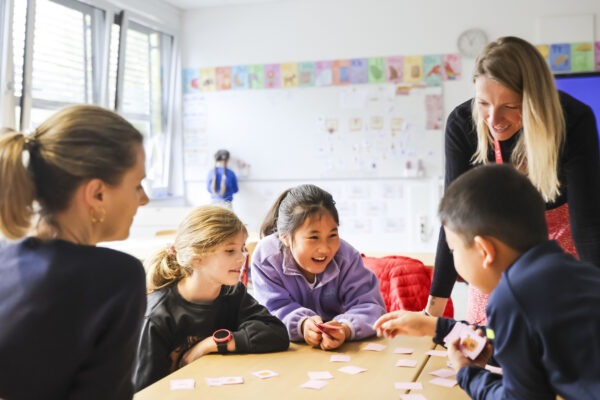
Smaller classes allow teachers to keep an eye on every student individually and to respond more specifically to different learning paces and strengths. When a teacher looks after fewer children, there is more time for personal feedback, differentiated assignments, and the early identification of difficulties.
In public elementary schools, classes of 25 to 30 children are not unusual. This makes it hard even for dedicated teachers to attend to each child individually. At private elementary schools, groups are deliberately kept smaller so that children don’t just keep pace with the average but can reach their full potential.
Especially for children who need additional support, class size makes a noticeable difference. When weaknesses in certain subjects are identified early, targeted support measures can be put in place before gaps become entrenched. Peer tutoring programs, in which older students support younger ones, are another tool that smaller schools can use flexibly.
What Role Does Multilingualism Play at Private Elementary Schools?
At many private elementary schools, multilingualism is not an add-on but a structural part of everyday teaching. Children learn in more than one language from the very beginning, which has been shown to strengthen cognitive skills such as problem-solving, concentration, and language awareness.
While public elementary schools in Germany usually don’t begin teaching English until third grade, many private international schools teach in English from first grade on and treat German as a structured required subject. This means children develop genuine proficiency in both languages from an early age, not just basic knowledge.
When Do Children Learn a Third Language?
In higher grades, a third language is often added. Depending on the school, the options include languages such as French, Spanish, Japanese, or Chinese.
Instruction in the third language focuses not only on vocabulary but on all dimensions of language:
- Reading comprehension
- Grammar
- Oral expression
- Writing skills
- Cultural awareness
This prepares children for a globalized world. It also significantly broadens their future academic and career opportunities.
Does a Private Elementary School Provide Better Preparation for Secondary School?
Yes, a well-structured private elementary school generally prepares children for secondary school in a more targeted way. It introduces formal assessment formats early, systematically closes academic gaps, and gradually introduces students to higher expectations.
Especially in grades 5 and 6, many private elementary schools intensify their preparation for secondary school. This includes a formal assessment plan with:
- Regular written tests
- Longer exams
- Final assessments in all subjects
As a result, children learn early on how to prepare for exams in a structured way, cope with exam pressure, and manage their time.
How Do Weekly Assessments and Academic Support Help Children?
Weekly assessments, for example 45-minute written tests alternating between English and math, ensure that learning gaps don’t go unnoticed. Academic support in small groups or through peer tutoring makes sure that no child falls behind. This combination of structure, support, and regular feedback creates a solid foundation for the transition to more demanding school years.
For Which Families Is a Private Elementary School the Right Choice?
A private elementary school is particularly well suited to families who value individual support, an international outlook, and a multilingual upbringing. It is also a good fit for families who have moved to a new country and are looking for a school where their children will be welcomed both linguistically and socially.
Specifically, the following families benefit most from a private elementary school:
- Families with an international background who are looking for an English-language learning environment
- Parents who want to prepare their children specifically for internationally recognized qualifications such as the Cambridge International General Certificate of Secondary Education (IGCSE) or the International Baccalaureate (IB) Diploma
- Families who have moved to Neuss, Düsseldorf, or the surrounding region and need a stable, structured school environment
- Parents for whom close collaboration with the school and transparent communication are important
- Families who see cultural diversity as an enrichment and want their children to grow up in a multinational environment
At the same time, a private elementary school is not a matter of prestige but a conscious decision in favor of a particular educational environment. If you want your child to learn in small groups, receive regular support, and grow up with several languages from the start, you will often find exactly what public schools cannot offer in this form at a private international school.
How Does ISR International School on the Rhine Put These Advantages Into Practice?
At ISR International School on the Rhine in Neuss, near Düsseldorf, Germany, we put exactly these strengths of a private elementary school into practice every day. Our ISR Elementary School near Düsseldorf offers a warm, structured, and internationally oriented learning environment in which children from more than 60 nations feel welcome from day one. The following features specifically set us apart:
- English as the language of instruction with German as a required subject, complemented by a third language from grade 6 (French, Spanish, Japanese, or Chinese)
- Weekly assessments to identify learning gaps early and provide targeted support
- Academic support in small groups as well as peer tutoring by older students
- A holistic learning program with music, art, physical education, computer science, drama, and social learning
- Individual onboarding with a personal meeting, a placement test, and an ambassador from the homeroom class on the first day of school
- Nonprofit status, with all revenue fully reinvested in the school
Would you like to learn more about how the ISR Elementary School program supports your child in the best possible way from the very beginning? We warmly invite you to attend one of the ISR Info Days and get to know ISR in person.

